
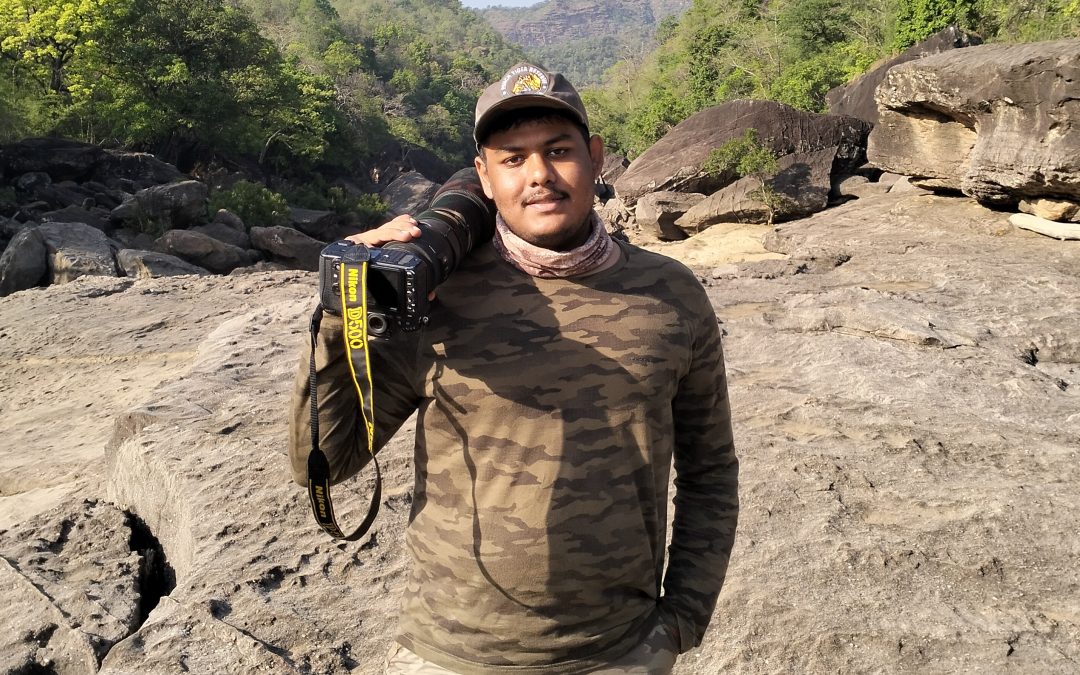
Adhiraj speaks to us about his journey, his field learnings and gives us and insight into a day in his life as a field biologist in Pench Tiger Reserve (Maharashtra) in Central India.
- Tell us more about yourself and what got you interested in working for the environment.
My name is Adhiraj Singh; I am 25 years old and I am currently working as Field Biologist at Pench Tiger Reserve Maharashtra with the Satpuda Foundation. I got interested in wildlife as a child and I loved watching wildlife documentaries, especially the ones which that featured wildlife filmmakers like Sir David Attenborough, Steve Irwin, Austin Stevens, Nigel Marven, Valmik Thapar etc. As someone born and brought up in Chandigarh in India, I spent my childhood in the Shivalik’s and the Terai landscape. My parents are very fond of nature and I spent my holidays wandering in the coniferous forests and Sal forests of these regions. As our neighboring state of Uttarakhand was home to Jim Corbett National Park, it was the first ever tiger reserve I ever went to and I grew up listening to its stories from the locals.
When I was around 10, my father got transferred to Pune, Maharashtra. One of my relatives was working with Forest Department was posted in central India. Whenever we got the opportunity, we would go to explore forests of Melghat, Pench, Tadoba & Kanha Tiger Reserves with them. I also started photographing wildlife using my father’s old camera which got me interested in carnivores, their ecology, how they behave, how they eat, everything got me curious. It was during this time that I saw Human-Wildlife conflict in the villages around Melghat and Pench, and realized that the wildlife I have always admired can sometimes create issues for people by raiding their crops, harming livestock and humans. This is when, I realized that I want to work in this sector to act as a bridge between wildlife & humans.
Following this, I started reading more about Wildlife Conservation, Ecology, Human Wildlife conflict and completed my Bachelors in Zoology and Masters in wildlife conservation action. I worked in the Banni landscape of Kutch for my thesis on desert fox & Desert cat, then worked with Global Tiger Forum in High altitude Tiger Project in Sikkim, followed by the Satpura Pench corridor project in Madhya Pradesh with WWF India before I joined as a Field Biologist at Pench with Satpuda Foundation.
- How does a typical day unfold for you? Tell us a bit about your daily tasks and conservation work.
My Day usually unfolds with checking on the GSM Camera traps (a wireless motion-activated camera trap, that uses cellular networks to instantly send photos and videos) that we have deployed across the Paoni Buffer and Territorial Range of Pench Tiger Reserve, Maharashtra. I check the camera traps on field and also through the SFTP (Secure File Transfer Protocol) servers, giving me real time surveillance of wildlife close to villages. We accordingly guiding the Forest Department staff on what areas need more frequent patrolling, which areas have high tiger movement and try to mitigate any kind of human wildlife conflict. Along with Tiger monitoring work I also work on trying to use the data obtained from camera traps to conduct species distribution modelling and time activity patterns that can help us understand what areas are preferred for movement by tigers, leopards and sloth bears.
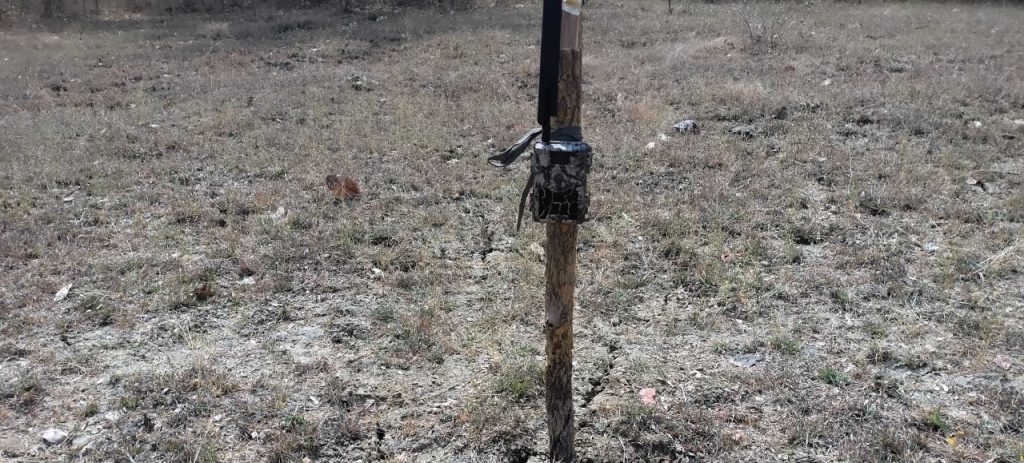
A camera trap deployed by Adhiraj and his team
- What do you love about your current job?
What I really love about my current job is the exposure that I receive as a biologist by working very closely with Forest department officials, National Tiger Conservation Authority as well as partner NGOs such as BNHS. In addition to the camera trap project, I have had the privilege to work very closely with forest department on the All India Tiger Estimation, butterfly survey, Crocodile Surveys, Asian Wetland Count, participating in tiger rescue operations, socio economic surveys and micro plans, giving me insights on how a tiger reserve management works.
Working on an innovative project of GSM camera traps, which unlike traditional camera traps give us real time updates on wildlife movements, is very fascinating for me. Moreover, integrating this technology with AI to give us faster updates make me realise the kind of advanced technological developments we are using in Wildlife Conservation which not many people have attempted yet, making this a one of its kind project.
- Could you share a key learning or experience from the field?
One key learning for me from the field is the importance of developing communication skills. In this sector I believe it is very important to develop communication & networking skills as this help you get tasks done more efficiently, and connect with people ranging from individuals working at grassroots level in the field, to senior most government officials. Moreover, good communication skills also help you develop yourself as a better leader & problem solver and even manage the tensest situations on field.
- Do you feel optimistic about the future of the natural environment of India? Have you experienced a positive change regarding conservation in your area?
Yes, I do have a positive feeling that India’s environment has a bright future. The current generations are realizing the potential of wildlife conservation and steadily, many young professionals are looking forward to using their passion and work towards a career in wildlife conservation. We can already see that population of tigers is rising, however we also need to work on their environment to sustain their growth and develop mitigation measures to avoid negative human wildlife interactions.
I have observed that people in Pench who used to have negative perspective about wildlife, and used to see them as menace, now see them as not only an important part of their daily life but also as something worth preserving. With changing times and education people are becoming more responsible towards conservation of environment and understanding the value of wildlife in their area.